
Parables of Jesus
(27 Parables Explained)

Judgment Day
Are You a Sheep or a Goat?
The Bible is filled with powerful imagery, and few parables are as striking and challenging as Jesus's description of the final judgment, often called the Parable of the Sheep and the Goats, found in Matthew 25:31-46.
This isn't just a story about farm animals; it's a foundational lesson on what true discipleship looks like and the surprising criteria by which the King will separate humanity at the end of the age.
The Setting: The Son of Man on His Throne
Jesus sets the scene with unparalleled majesty:
"When the Son of Man comes in his glory, and all the angels with him, then he will sit on his glorious throne. Before him will be gathered all the nations, and he will separate people one from another as a shepherd separates the sheep from the goats..." (Matthew 25:31-32)
This is the climactic moment, the ultimate culmination of history. It's not a secret meeting; it's a public, final, and universal judgment by the triumphant Christ. The separation isn't arbitrary; it's the natural result of lives lived in one of two fundamental ways.
The Criteria: Service to the Least of These
The heart of the parable is the reason given for the separation.
The Sheep (The Righteous)
The King welcomes the "sheep" to inherit the kingdom, declaring that their acts of mercy and service to others were, in fact, acts of service to Him:
"For I was hungry and you gave me food, I was thirsty and you gave me drink, I was a stranger and you welcomed me, I was naked and you clothed me, I was sick and you visited me, I was in prison and you came to me." (Matthew 25:35-36)
The astonishing twist is the response of the righteous: "Lord, when did we see you...?" (v. 37). Their acts were so natural, so selfless, and so focused on the need before them that they didn't even realize they were serving the King Himself.
The King's reply is the golden key to this parable:
“Truly, I say to you, as you did it to one of the least of these my brothers, you did it to me.” (Matthew 25:40)
The Goats (The Cursed)
Conversely, the "goats" are sent away because they failed to perform these simple acts of compassion. Their condemnation is based not on what they did (murder, stealing, etc.), but on what they failed to do—the sins of omission.
“Truly, I say to you, as you did not do it to one of the least of these, you did not do it to me.” (Matthew 25:45)
Three Life-Altering Takeaways
1. Faith Expressed in Action
This parable powerfully reminds us that faith without works is dead (James 2:17). The separation is not based on saying the right words or even professing faith, but on tangible evidence of a transformed heart. Our faith must flow outward into practical love for our neighbor.
2. The Kingdom is Found in the Marginalized
Jesus fundamentally re-orients our focus. He equates Himself with "the least of these" (v. 40). If you want to find Jesus today, don't just look in glorious cathedrals—look in the food pantry, the hospital ward, the homeless shelter, and the refugee camp. These are the places where the King has chosen to make His presence known through the eyes of the hurting.
3. The Surprising Nature of True Righteousness
Both the sheep and the goats are surprised by the King's judgment. The sheep never boasted of their service, and the goats never realized their inactivity was damning. True righteousness, according to Jesus, is not self-aware or performed for a heavenly reward; it is simply the natural, humble outflow of a heart that loves God and, therefore, loves the people God places in front of it.
Are you living a life that naturally serves the "least of these"?
The Parable of the Sheep and the Goats is not a threat, but a mirror. It forces us to look past our religious words and examine our hands. What are they doing? Are they reaching out to help? Because in those simple, often-unseen acts of service, we are reaching out and serving the King of Glory Himself.
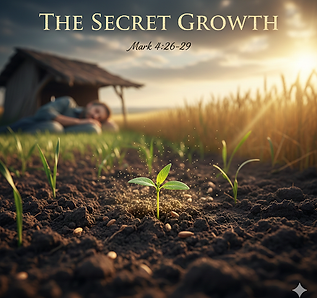
The Secret Growth
Why We Can Rest While God Works
The Parable of the Growing Seed
(Mark 4:26-29)
Have you ever planted a seed? You bury that tiny, hard speck in the dirt, water it, and then... you wait. Day after day, you check the soil, but nothing seems to be happening. Then, one morning, a tiny green shoot breaks the surface. It’s a miracle of nature, and in this simple process, Jesus reveals a profound truth about the Kingdom of God.
In Mark 4:26-29, nestled between the Parable of the Sower and the Parable of the Mustard Seed, is the often-overlooked Parable of the Growing Seed.
“And he said, ‘The kingdom of God is as if a man should scatter seed on the ground. He sleeps and rises night and day, and the seed sprouts and grows; he knows not how. The earth produces a harvest by itself, first the blade, then the ear, then the full grain in the ear. But when the grain is ripe, at once he puts in the sickle, because the harvest has come.’” (Mark 4:26-29, ESV)
This short parable offers immense comfort and correction for those of us striving to serve God.
1. The Divine Autonomy of Growth
The most striking part of this story is the farmer's role—or lack thereof—in the actual growth. The farmer “sleeps and rises night and day,” completely unaware of the mysterious process happening beneath the surface. The text emphasizes: “the seed sprouts and grows; he knows not how.”
What does this tell us?
* Our Responsibility is Sowing, Not Growing: Our job is to sow the seed—to share the Gospel, to teach, to live a life of love, and to serve faithfully. Once the seed of God's Word is planted, the growth is handled by a power infinitely greater than ours.
* Release the Anxiety of Results: How many times do we fret over a friend who hasn't accepted Christ, a child who has wandered, or a ministry that seems stagnant? This parable is an invitation to rest in the sovereignty of God. We are not the source of life; Christ is. The power for spiritual growth, conviction, and transformation resides in the Holy Spirit, not in our clever programs or persuasive arguments.
2. The Inexorable Process: "The earth produces a harvest by itself"
The phrase “The earth produces a harvest by itself” (or automátē in the Greek) suggests a natural, powerful, and unstoppable force. It means the seed, once planted, is inherently designed by God to grow.
This speaks to the power and vitality of the Word of God. The Bible is not dead literature; it is living and active (Hebrews 4:12). When it is faithfully sown, it will do its work.
“For as the rain and the snow come down from heaven and do not return there but water the earth, making it bring forth and sprout, giving seed to the sower and bread to the eater, so shall my word be that goes out from my mouth; it shall not return to me empty, but it shall accomplish that which I purpose, and shall succeed in the thing for which I sent it.” (Isaiah 55:10-11, ESV)
The growth is guaranteed because the seed (the Word) and the power (the Spirit) are divine. We are merely the stewards of the soil.
3. The Patient Progression: Blade, Ear, Full Grain
The growth happens in distinct stages: “first the blade, then the ear, then the full grain in the ear.” Spiritual maturity is a process, not a switch.
* Encouragement for the "Blade": We shouldn't despise small beginnings. A newborn Christian or a new ministry may look like a tiny blade, easily overlooked. But that blade is a promise of the full harvest to come. We must practice patience—with ourselves, with new believers, and with the timing of God.
* A Call for Endurance: The farmer doesn't harvest at the blade stage. He waits until the “full grain in the ear.” God's work in a life is always moving toward completion and maturity. He is faithful to finish what He started (Philippians 1:6).
A Resting Faith
The Parable of the Growing Seed is Jesus’ permission for us to breathe. It allows us to release the burden of producing spiritual fruit and place it back where it belongs—on the Spirit of God.
We are called to be faithful sowers, but we must also be resting believers. We can go to sleep at night knowing that the Kingdom of God is growing, not by our sleepless effort, but by the mysterious, unstoppable, and glorious power of God Himself.
Our faith is not in our gardening skills, but in the life-giving power of the Seed.
What "seed" are you sowing right now? Are you able to rest in God's power, or are you trying to force the growth?

The Light That Can't Be Hidden
What Does the Lamp Under a
Bushel Mean for You?
The teachings of Jesus are often profound yet beautifully simple, wrapped in metaphors that speak to the heart of everyday life. One such powerful image is the parable of the lamp under a bushel, found in the Gospels of Matthew, Mark, and Luke.
While the context varies slightly in each account, the core message is a direct challenge to every believer: Your faith, your gifts, and your good works are meant to be seen.
The Scripture: A Light on a Stand
Let's look at one of the clearest renditions of this teaching:
“Nor do people light a lamp and put it under a basket, but on a stand, and it gives light to all in the house. In the same way, let your light shine before others, so that they may see your good works and give glory to your Father who is in heaven.”
— Matthew 5:15-16 (ESV)
In first-century Israel, a "bushel" (modios) was a common measuring basket, typically holding dry goods like grain. To put a precious, expensive lamp—the only source of light in a dark home—under such an object would be foolish, even absurd. It would not only extinguish the light but also risk setting the house on fire!
3 Reasons Why We Hide Our Light
Jesus’s listeners would have instantly grasped the practical absurdity of the image. Yet, how often do we, as Christians, commit a spiritual absurdity by covering our own light? Why do we do it?
1. The Bushel of Fear
We fear judgment, criticism, or rejection. We worry about what friends, family, or colleagues will think if we openly share our faith or stand up for our Christian values. This fear acts like a heavy blanket, suffocating the very light God designed to shine brightly.
2. The Bushel of Humility (Misunderstood)
Sometimes, we confuse genuine humility with hiding. We think that by not sharing our gifts or our testimony, we are being humble. But true biblical humility is recognizing that your gifts come from God and then using them boldly for His glory—not for your own. Jesus didn't call us to be invisible; He called us to be salt and light (Matthew 5:13-14).
3. The Bushel of Apathy
We get comfortable. We confine our faith to Sunday mornings and private moments, seeing no urgent need to let it spill over into our workplace, social circles, or neighborhood. This apathy suggests we don't believe the "light" (the Gospel and our good deeds) is truly necessary for the world around us.
Your Call to Action: Remove the Bushel
The command in this passage is clear: “Let your light shine before others.”
Our light is not a personal possession to be hoarded; it is a witness to the power and love of God. When we remove the bushel, our light does two vital things:
* It illuminates the path for others: Our consistency, integrity, kindness, and readiness to share the hope we have in Christ can draw people toward the source of that light.
* It glorifies the Father: Notice the end of the verse: "...so that they may see your good works and give glory to your Father who is in heaven.” The ultimate goal is not for people to praise us but for them to look past our good works and acknowledge the divine source—God Himself.
Reflection and Prayer
This week, ask yourself: What is the "bushel" in my life right now? Is it fear of speaking up? Is it laziness in using my spiritual gifts? Is it the mistaken belief that my little light won't make a difference?
The world is dark. A single, focused, and persistent lamp is exactly what is needed. Take courage, remove the covering, and let the light of Christ within you illuminate your corner of the world.
Heavenly Father, thank you for lighting our lives with the Gospel of your Son, Jesus Christ. Forgive us for the times we have hidden your light out of fear or indifference. Give us the boldness and wisdom to live such lives of integrity and love that others are drawn to you. In Jesus' name, Amen.
(13)
(14)
(15)