
Parables of Jesus
(27 Parables Explained)
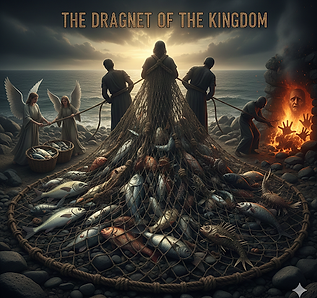
The Dragnet of the Kingdom
Understanding the Parable of the Net
The Kingdom of Heaven is like... a fishing net?
This might not be the most famous of Jesus's parables, but the Parable of the Net, found in Matthew 13:47–50, is a powerful conclusion to Jesus's series of parables about the nature of the Kingdom. Sandwiched between the Parables of the Pearl of Great Price and the Householder, this short illustration offers a sober and vital reminder about God's plan for the end times.
The Scene: A Massive Catch
Jesus said:
"Again, the kingdom of heaven is like a net that was thrown into the sea and caught fish of every kind. When it was full, men drew it ashore and sat down and sorted the good into containers but threw away the bad. So it will be at the end of the age. The angels will come out and separate the evil from the righteous and throw them into the fiery furnace. In that place there will be weeping and gnashing of teeth." (Matthew 13:47–50, ESV)
The type of net described here is a dragnet (Greek: sagenē), a massive, sweeping net used to enclose a vast area of the sea. It doesn't catch just one kind of fish; it indiscriminately scoops up everything in its path—edible, inedible, clean, and unclean.
Unpacking the Symbols
Like the Parable of the Weeds, this story has an explicit interpretation given by Jesus, making its meaning crystal clear:
The Kingdom of Heaven | The Net (The Church/Gospel Mission)
The Sea | The World
Fish of Every Kind | All people, good and bad
The Catching | The Gospel being proclaimed worldwide, gathering all people into the visible church.
The Dragging to Shore | The End of the Age/Judgment Day
The Separators | The Angels
The Good Fish | The Righteous/True Believers
The Bad Fish | The Evil/False Professors
The Fiery Furnace | Eternal Judgment/Hell
1. The Time for Gathering (Now)
The dragnet represents the expansive reach of the Gospel and the visible church in the world today. It pulls in people from every nation, background, and moral state.
Crucially, the net is indiscriminate. Right now, within the confines of churches, ministries, and general Christian circles, there is a mix. There are true, devoted followers of Christ and those who merely appear religious, who profess faith but whose hearts are far from God.
The message for the believer today is patience and focus: We are in the era of mission and evangelism. Our job is to cast the net wide, not to pre-judge or prematurely separate the catch. That phase is not our responsibility.
2. The Time for Separation (Later)
This is the hard, unavoidable truth of the parable: separation is guaranteed.
Just as the fish are not sorted until the net is full and dragged to the shore, the ultimate division between the righteous and the wicked will not happen until the "end of the age." This separation will be absolute and final, carried out perfectly by the angels.
Key Takeaway: Our final standing is not determined by our association with the Church, but by our relationship with Christ. Simply being "in the net" (i.e., attending church, being baptized) is not enough. The separation depends on whether we are genuinely "good fish" (the righteous), defined by true faith and the fruit it produces.
A Sobering Call to Self-Examination
The Parable of the Net serves as a powerful call to serious self-reflection:
* Are you a "good fish"? Do you possess the genuine, saving faith that Jesus calls for, or are you merely a bad fish hidden among the good?
* The quality of your commitment?
The Parable of the Sower warned of seeds with shallow roots. The Parable of the Net warns of those whose presence in the community is external but whose inner life is unchanged.
The final judgment will be a time of intense weeping and gnashing of teeth for those who thought they were safe but are ultimately cast away. Let this parable motivate you today to confirm the hope that is in you and live a life worthy of the calling you have received.
Reflection Question
How does the guarantee of a future, final separation change the way you live your Christian life today?
Share your comments below.

The Unforgivable Debt
Lessons from the Unmerciful Servant
The Bible is full of powerful stories that challenge us and reveal the heart of God. One of the most striking—and perhaps most convicting—is the Parable of the Unmerciful Servant, found in Matthew 18:21-35.
This parable is more than just a cautionary tale about debt; it is a profound illustration of forgiveness, mercy, and the dangerous contradiction of receiving grace but refusing to give it.
The King’s Radical Mercy
The story begins with a servant who owes his king an astronomical sum: 10,000 talents.
“Therefore the kingdom of heaven may be compared to a king who wished to settle accounts with his servants. When he began to settle, one was brought to him who owed him ten thousand talents.” (Matthew 18:23-24 ESV)
To grasp the magnitude of this debt, consider this: one talent was roughly equivalent to 15 years' wages for a laborer. 10,000 talents was an unpayable, generational debt—a debt so large it almost certainly represented the gross mismanagement or theft of the king’s entire treasury. The servant was utterly ruined, facing bondage for himself and his family.
When the servant fell to his knees, begging for patience, the king did something astonishing. He didn't just grant a repayment plan; he granted complete and total cancellation:
“And out of pity for him, the lord of that servant released him and forgave him the debt.” (Matthew 18:27 ESV)
This King represents God, and the enormous debt represents our sin. No matter how great our spiritual debt is, God is willing to extend radical, unearned, and complete forgiveness through Christ Jesus.
The Tragic Contradiction
The real tragedy of the parable unfolds immediately after the servant is freed.
Having just experienced the greatest act of financial mercy imaginable, the servant immediately encounters a fellow servant who owes him a comparatively tiny sum: 100 denarii.
“But when that same servant went out, he found one of his fellow servants who owed him a hundred denarii...” (Matthew 18:28 ESV)
The contrast is staggering. The forgiven debt was literally hundreds of thousands of times greater than the debt owed to him. Yet, when his fellow servant begged with the exact same plea he himself had used moments before, the unmerciful servant refused.
He seized him, choked him, and had him thrown into prison until the small debt could be paid.
This action reveals a devastating truth: he never truly grasped the gravity of the forgiveness he received. His heart remained hard, his perspective selfish, and his mercy was nonexistent.
The King’s Righteous Judgment
When the king heard what had happened, his reaction was one of righteous anger:
“Then his lord summoned him and said to him, ‘You wicked servant! I forgave you all that debt because you pleaded with me. And should not you have had mercy on your fellow servant, as I had mercy on you?’ And in anger his lord delivered him to the jailers, until he should pay all his debt.” (Matthew 18:32-34 ESV)
The King's judgment here is not a retraction of initial grace, but a consequence for the servant's hypocritical and unrepentant heart. The king's mercy was conditioned on the nature of the servant's heart, a nature that was revealed to be devoid of grace.
The lesson is summarized by Jesus Himself:
“So also my heavenly Father will do to every one of you, if you do not forgive your brother from your heart.” (Matthew 18:35 ESV)
Practical Reflections for Today
This parable is a spiritual mirror, compelling us to look at our own hearts.
* Recognize Your Debt: Do you truly appreciate the impossible debt of sin God has cancelled for you through the cross of Jesus Christ? A deeper appreciation of our own forgiveness fuels our desire to forgive others.
* Release the Small Debts: Who owes you a "100 denarii"? It could be a spouse who spoke harshly, a friend who betrayed trust, a co-worker who slighted you, or an old resentment you’ve held onto. When we refuse to forgive, we essentially declare that the small injury done to us is more important than the infinite grace we received from God.
* Forgive From the Heart: Jesus emphasizes that forgiveness must be genuine—"from your heart." It’s not just a declaration; it’s releasing the bitterness, letting go of the demand for payment, and handing the offense entirely over to God.
The true mark of a forgiven soul is a forgiving spirit. Let us not be like the unmerciful servant, trading in the magnificent gift of God's grace for the bitter bondage of unforgiveness.
What grudges are you still holding onto? How can a fresh appreciation of God's forgiveness empower you to release that debt today?

The Workers in the Vineyard
God's Economy of Grace
An Ancient Parable for Modern Disciples
The Gospel of Matthew is rich with the teachings of Jesus, and few are as challenging and profoundly comforting as the parable of The Workers in the Vineyard (Matthew 20:1-16). At first glance, the story might seem to be about fairness and labor laws. But Jesus wasn't teaching a lesson in economics; He was revealing the radical, overwhelming nature of God's grace and the Kingdom's economy.
The Story: A Lesson in Disappointment
The parable begins simply: a landowner goes out early in the morning to hire workers for his vineyard, agreeing to pay them the customary denarius (a day's wage). Throughout the day—at the third, sixth, ninth, and even the eleventh hour (just an hour before quitting time)—he continues to hire more workers.
When evening comes, the landowner instructs his foreman to pay everyone, starting with those who worked the least. The final workers—those who toiled for only one hour—are each given a full denarius.
Then, the first workers step up. Expecting more, they are shocked and angered to receive the same promised denarius.
“These last men have worked only one hour, and you have made them equal to us who have borne the burden of the day and the scorching heat.” (Matthew 20:12)
What is the Denarius? It's Not Your Wage, It's God's Gift
The workers' complaint is understandable from a human perspective. Their frustration exposes our natural, deep-seated sense of meritocracy: I worked harder, so I deserve more.
However, in this parable, the denarius represents far more than money: it is the gift of eternal life and a place in God's Kingdom.
* The Early Workers: These represent those who have served God faithfully for a long time, often bearing the "burden" of religious discipline and sacrificial living.
* The Late Workers: These represent those who come to faith later in life, perhaps in their final years, or even those who convert dramatically at the "eleventh hour."
The landowner's response cuts straight to the heart of the Gospel:
“Friend, I am doing you no wrong. Did you not agree with me for a denarius? Take what belongs to you and go. I choose to give to this last man as I give to you.” (Matthew 20:13-14)
The landowner holds them to the agreement they made. They were paid exactly what they were promised. Their grievance wasn't about their wage; it was about the generosity shown to others.
A Radical Truth: God's Generosity vs. Human Jealousy
This parable drives home two radical truths about the Kingdom of Heaven:
1. Grace is Unmerited and Undiluted
Salvation is not an hourly wage based on performance; it is a gift based on the generosity of the Giver. Whether you were called at the beginning of your life or the end, the full bounty of God’s grace—the denarius of salvation—is the same. Your long years of service do not earn a "bigger heaven." This truth levels the playing field: we are all utterly dependent on God's mercy.
2. God’s Goodness Should Inspire Joy, Not Jealousy
The landowner asks a pivotal question:
“Is it not lawful for me to do what I wish with my own things? Or is your eye envious because I am generous?” (Matthew 20:15)
Our human tendency is to compare. When we see a latecomer to the faith receive the same blessing, the same forgiveness, or the same love that we received after years of struggle, we can be tempted toward jealousy. But God reminds us that His infinite generosity is not a limited resource. When He is good to someone else, it does not mean He is less good to us. His goodness is something to celebrate, not resent.
Reflection: Where Are You in the Vineyard?
Regardless of when you entered the vineyard, your blessing is secure in Christ. If you are an Early Worker, remember your calling is a privilege, not a contract for superior reward. Celebrate God's boundless kindness to all who answer His call. If you are an Eleventh-Hour Worker, rejoice that God’s love extends to you, regardless of how little time remains. Start working immediately!
In the Kingdom of God, the last shall be first, and the first shall be last (Matthew 20:16)—not in a punishing sense, but in a profound testament to the power of pure, unadulterated grace.
What does this parable say to you about your own service in the church or the world? Share your thoughts in the comments below.
(7)
(8)
(9)