
Parables of Jesus
(27 Parables Explained)

The Tale of Two Sons
Obedience, Repentance, and
the Father's Heart
The Bible is full of powerful stories, and one of the shortest yet most profound is Jesus' parable of the two sons, often found immediately preceding the Parable of the Wicked Tenants in the Gospel of Matthew (Matthew 21:28-32). This simple tale, told directly to the chief priests and elders, exposes the difference between outward profession and true obedience, and it reveals the beautiful, persistent heart of God the Father.
The Parable: A Snapshot of Contradiction
The setup is straightforward: a father asks his two sons to go and work in his vineyard.
* The First Son: When asked, he gives an immediate and disrespectful "No, I will not." However, afterward he regretted it and went.
* The Second Son: He responds with a polite and pious, "I go, sir," but then he did not go.
Jesus then poses the direct question to his listeners: "Which of the two did the will of his father?" The answer is undeniable: The first.
The Meaning: Actions Speak Louder
This parable serves as a sharp indictment against religious hypocrisy and a loving invitation to true repentance.
1. The Danger of Empty Words (The Second Son)
The second son represents those who make a grand show of religiosity—those who say all the right things, use all the appropriate spiritual language, and promise obedience, yet whose actions are empty.
* He outwardly honors the father ("I go, sir") but inwardly disobeys.
* In Jesus' context, this son symbolized the religious leaders of the day—the chief priests and elders—who claimed to be following God's Law but rejected the very Messiah God had sent. They had the right words of faith but the wrong deeds of rejection.
Key Takeaway: Saying "yes" to God is only the first step. True discipleship is evidenced by putting on your boots and actually walking into the vineyard.
2. The Power of Repentance (The First Son)
The first son represents those who initially reject God, perhaps even living openly in sin or rebellion, but who experience a genuine, life-altering change of heart.
* He starts with a brazen "No," symbolizing an outright rebellion against God's will.
* But he regrets it (repents) and then goes (obeys). His initial transgression is completely canceled out by his final, decisive action of obedience.
* Jesus explicitly links this son to the tax collectors and prostitutes—people society scorned, who heard the message of repentance from figures like John the Baptist, believed it, and changed their lives. They started outside the vineyard but ended up working in it.
Key Takeaway: Your past rejection of God does not define your future. Genuine repentance (the turning around) is what God values, and it always leads to active obedience.
The Father’s Priority: Sincerity over Status
The most beautiful part of this parable is what it tells us about the Father. The Father doesn't care about the initial polite response or the religious status of the sons. He cares about sincere action and willingness to change.
* God is less concerned with our religious reputation and more concerned with our responsive heart.
* He is pleased by the rebellious soul who turns and walks toward the light, demonstrating that true faith is always an active choice of the will.
Jesus concluded the teaching by stating that the repentant tax collectors and prostitutes would enter the Kingdom of God before the religious elite (Matthew 21:31). This is because the outwardly rebellious sons showed genuine repentance and obedience, while the outwardly religious sons showed only talk and disobedience.
Application for Today
So, which son are you today?
* Are you the Second Son, saying the right prayers and attending the right meetings, but neglecting the daily work of love, justice, and personal holiness that God has called you to? Be warned: empty faith is no faith at all (James 2:14-17).
* Are you the First Son, who might have stumbled or rebelled, but whose heart is now genuinely broken over your sin and motivated to get up and start working for the Lord? Be encouraged: Your repentance is accepted, and your obedience is valued!
The vineyard is open, and the Father is waiting. The true test of faith is not what we say, but what we ultimately do.
How does this parable challenge your own understanding of obedience?
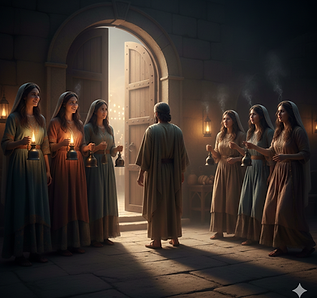
Ready or Not?
The Timeless Lesson of the Ten Virgins
The parables of Jesus are not just quaint stories; they are profound, layered teachings designed to illuminate the realities of God’s kingdom and the path to eternal life. One of the most urgent and compelling is the Parable of the Ten Virgins, found in Matthew 25:1-13.
This isn't a lesson about wedding planning—it's a stark, vital message about preparedness for the return of the Bridegroom, Jesus Christ.
The Setup: Waiting for the Bridegroom
Jesus begins, "The kingdom of heaven will be like ten virgins who took their lamps and went out to meet the bridegroom" (Matthew 25:1).
In ancient Jewish wedding customs, the groom, often accompanied by his friends, would arrive late in the evening or even at midnight to bring his bride from her father's house to his own, where the marriage feast would commence. The ten virgins—likely the bride's friends—were given the honor of lighting the way, a joyful and crucial role.
The key players:
* The Bridegroom: Universally understood as a representation of Jesus Christ.
* The Virgins: They represent those who profess to be followers of Christ, waiting for His Second Coming.
* The Lamps: The outward sign of their profession of faith; a life lived in the light of God's truth.
The Division: Wise vs. Foolish
Jesus immediately divides the group: "Five of them were foolish, and five were wise. For when the foolish took their lamps, they took no oil with them, but the wise took flasks of oil with their lamps" (Matthew 25:2-4).
They all looked the same on the surface. They all had lamps. They all had the intent to wait. The difference was a small, seemingly minor detail that became a world-altering deficiency: The Oil. While interpretations of the oil vary, the consensus points to something deeply personal and indispensable:
* The Holy Spirit: The Spirit of God is often symbolized by oil in scripture (as in anointing). The Spirit is what truly lights and sustains the believer's life.
* A Deep, Enduring Faith: The consistent practice of obedience, prayer, and devotion that sustains one's spiritual life through a long, unexpected wait.
* The "Oil" is the Inner Life: The foolish virgins had the outward form of godliness (the lamp), but they lacked the inner, sustaining reality (the oil).
The Crisis: "Behold, the Bridegroom!"
The text continues: "As the bridegroom was delayed, they all became drowsy and slept. But at midnight there was a cry: 'Here is the bridegroom! Come out to meet him'" (Matthew 25:5-6).
The delay is inevitable, and they all slept. Sleeping wasn't the problem—being unprepared when the alarm sounded was the tragedy. When the call came, a frantic scene unfolded:"The foolish said to the wise, 'Give us some of your oil, for our lamps are going out.' But the wise answered, saying, 'Since there will not be enough for us and for you, go rather to the dealers and buy for yourselves'" (Matthew 25:8-9).
Here is the heartbreaking truth of this parable: You cannot borrow salvation. The inner, sustaining reality of faith (the oil) cannot be transferred from one person to another. Each person must cultivate and maintain their own relationship with God.
The Lockout: The Door Was Shut
While the foolish virgins were scrambling to "buy" (or quickly manufacture) the inner light they had neglected for so long, the Bridegroom arrived.
"And while they went to buy, the bridegroom came, and those who were ready went in with him to the marriage feast, and the door was shut" (Matthew 25:10).
When the foolish virgins finally returned, their plea was desperate: "Lord, Lord, open to us!" But the chilling, irreversible response came: "Truly, I say to you, I do not know you" (Matthew 25:11-12).
This isn't just about a missed party; it’s about a final, eternal separation. The door being shut signifies the end of opportunity—the moment when our time for preparation is over. The Lord's words, "I do not know you," reveal that their outward profession was never matched by an inner, living reality.
The Urgent Call: Keep Watch
Jesus concludes the parable with a sharp and direct command:"Watch therefore, for you know neither the day nor the hour." (Matthew 25:13)
The key takeaway is this: Every person who names the name of Christ has a lamp. The question this parable forces us to answer is: Do you have the oil?
Are you relying on the surface-level appearance of faith (attending church, using Christian jargon), or are you cultivating the inner life?
* For the "Wise": Don't become complacent. The wait can be long. Keep seeking the Holy Spirit, keep praying, keep reading scripture, and keep living in obedience.
* For the "Foolish" (or the Unsure): The door is still open now. Do not delay the cultivation of your inner spiritual life. Today is the day to go get the oil—to repent, to invite the Holy Spirit in, and to begin the serious work of a sincere, enduring relationship with the Bridegroom.
The Bridegroom is coming. Let us be among those who are not just waiting, but are ready when the cry sounds!
Reflection Question:
If the Bridegroom were to return tonight, would your lamp still be burning brightly, or would you find yourself desperately needing oil? preparedness?
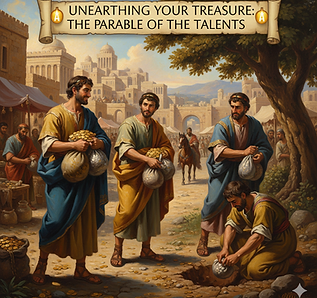
Unearthing Your Treasure
The Parable of the Talents
The call to follow Jesus is a call to action, not idleness. Yet, many of us wrestle with the question: What am I supposed to do for the Kingdom of God? The answer, as it often is, can be found in a simple, yet profound story Jesus told—the Parable of the Talents.
Found in Matthew 25:14–30, this parable is much more than a lesson on finance; it's a vital truth about stewardship, obedience, and the resources God has entrusted to us.
The Master's Trust and
the Servants' Charge
The story begins with a man (representing God, or Christ) preparing to go on a journey. Before leaving, he entrusts his property to three servants. Crucially, the master distributes his wealth "according to his ability" (Matthew 25:15):
* One servant receives five talents.
* Another receives two talents.
* The last receives one talent.
A "talent" in that era was an enormous sum of money—perhaps equivalent to fifteen or twenty years of a laborer’s wages! This initial detail is critical: God gives us resources in proportion to what we are capable of handling. Your calling might look different from your neighbor's, but both are equally valuable to the Master.
Action vs. Paralysis
Upon receiving their charge, the first two servants immediately put the money to work:
“The one who had received the five talents went at once and traded with them, and he made five talents more. So also the one who had the two talents made two talents more.” (Matthew 25:16-17)
These servants demonstrated faithfulness and initiative. They didn't wait for a detailed instruction manual; they understood the master expected a return, and they acted decisively.
However, the third servant chose a different path:
“But the one who had received the one talent went and dug a hole in the ground and hid his master’s money.” (Matthew 25:18)
His inaction wasn't due to a lack of ability, but a lack of courage and a misunderstanding of his master's character. He buried his potential out of fear.
The Master's Accounting
When the master returned, he held his servants accountable. The response to the faithful servants is one of the most encouraging passages in all of scripture:
“His master said to him, ‘Well done, good and faithful servant. You have been faithful over a little; I will set you over much. Enter into the joy of your master.’” (Matthew 25:21, 23)
Notice that the reward is the same for the servant who doubled five talents and the servant who doubled two. The master's praise is based on faithfulness and effort, not the total quantity of the return. Both used what they were given to the best of their ability.
The third servant, however, faced condemnation. He presented his excuse: he was afraid the master was a harsh man, so he protected the one talent rather than risking it.
The master's judgment was severe, not because the servant failed to earn ten talents, but because he was wicked and lazy. He refused to even take the minimal risk of depositing the money to earn interest (Matthew 25:27). The one talent was taken from him and given to the one who had ten, illustrating the principle: "to everyone who has, more will be given... but from the one who has not, even what he has will be taken away" (Matthew 25:29).
What Are Your Talents?
While the parable speaks literally of money, Christians have historically understood the "talents" as a representation of all the gifts, opportunities, resources, time, and abilities God has given us.
Here are three key takeaways for unearthing your treasure:
1. Identify Your Gifts
What are you naturally good at? Do you have a talent for hospitality, organization, teaching, listening, creativity, or encouragement? Every genuine gift you possess—whether it feels spiritual or practical—is a talent from God meant to be used for His glory and the good of others.
2. Overcome the Fear of Failure
The greatest barrier to using our talents is the fear of losing them or failing in our endeavors. Like the third servant, we often prefer to bury our gifts out of a desire for self-protection. God calls us to a life of risk-taking faith, not timid self-preservation.
3. Start Small, Be Faithful
You don't need five talents to begin. If you have one talent—one skill, one opportunity, one hour of time—use it faithfully. Start small in your church, your family, or your community. True success in God's Kingdom is measured by your stewardship of the little you have, not the size of the results you achieve.
A Final Thought
The Parable of the Talents is a serious reminder that we are all temporary managers of God's resources. One day, the Master will return, and the accounting will take place.
Don't let your gifts lie dormant out of fear or laziness. Invest your time, your passion, and your unique abilities today. When you hear the Master say, "Well done, good and faithful servant," the return will be worth every effort.
What's one "talent" (gift or resource) God has given you that you need to "invest" this week? Share your thoughts in the comments below!
(10)
(11)
(12)