Self-Righteousness
- Michael W.
- Nov 7, 2025
- 4 min read

How Not to Be
Have you ever met someone who just seems to have it all together? They never miss a Bible study, they always know the right theological answer, and their social media feed is a picture of Christian perfection. While there's nothing wrong with striving for holiness, sometimes this pursuit can veer dangerously into what the Bible calls self-righteousness.
Self-righteousness is a subtle, corrosive poison. It's the belief that our own good works, our obedience, or our superior understanding of the faith makes us more acceptable to God—or, often more accurately, makes us superior to others. It’s the opposite of the humble, dependent faith that God truly desires.
So, how do we spot this spiritual trap in our own lives, and more importantly, how do we steer clear of it?
1. The Pharisee's Prayer: The Biblical Warning
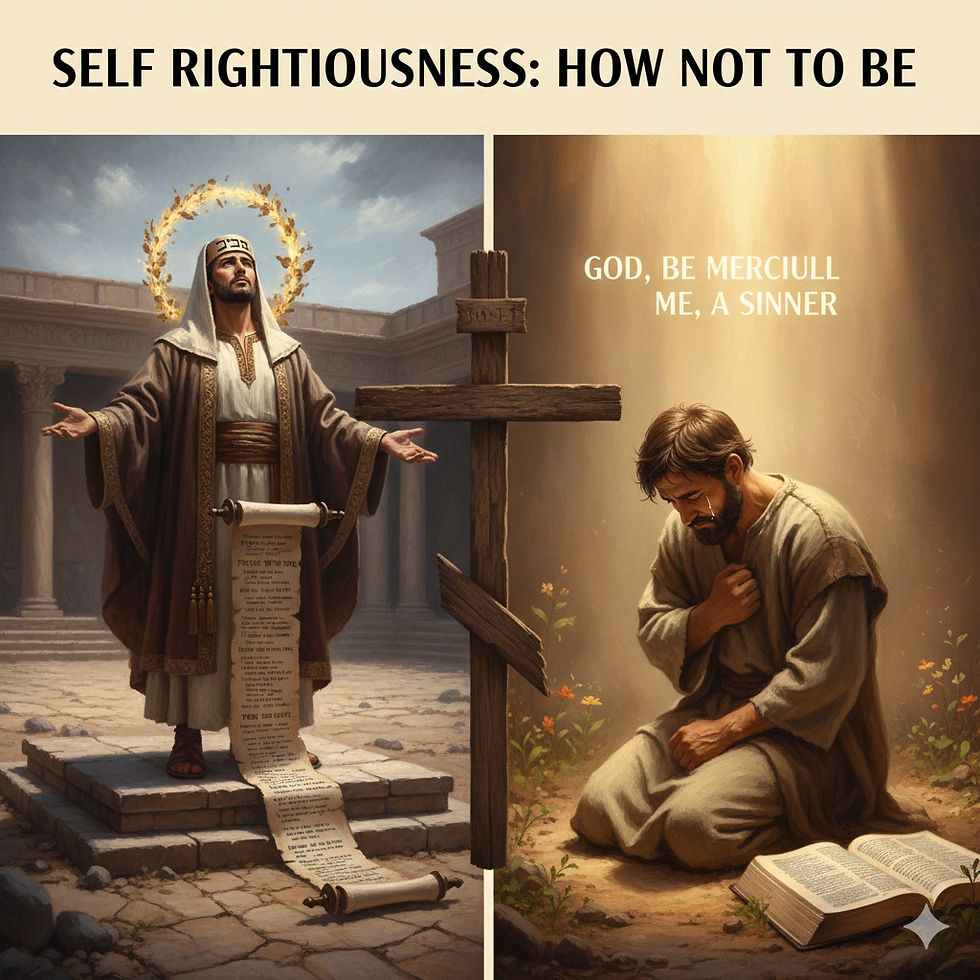
The clearest biblical picture of self-righteousness comes from Luke 18:9-14, the parable of the Pharisee and the Tax Collector.
He also told this parable to some who trusted in themselves that they were righteous, and treated others with contempt: “Two men went up into the temple to pray, one a Pharisee and the other a tax collector. The Pharisee, standing by himself, prayed thus: ‘God, I thank you that I am not like other men, extortioners, unjust, adulterers, or even like this tax collector. I fast twice a week; I give tithes of all that I get.’ But the tax collector, standing far off, would not even lift up his eyes to heaven, but beat his breast, saying, ‘God, be merciful to me, a sinner!’ I tell you, this man went down to his house justified, rather than the other. For everyone who exalts himself will be humbled, but the one who humbles himself will be exalted.”
The Pharisee was doing everything right outwardly: fasting, tithing, praying. But his prayer reveals a heart full of pride and contempt for others. He wasn't seeking God; he was showcasing his performance. The Tax Collector, however, had nothing to boast about, only his need for mercy.
The takeaway is clear: God justifies the one who recognizes their sin and pleads for mercy, not the one who proudly lists their good deeds.
2. The Symptoms of Self-Righteousness
How can you check your own spiritual pulse? Self-righteousness doesn't usually announce itself with a trumpet blast. It sneaks in.
The Spirit of Comparison: You find yourself constantly measuring your spiritual performance against others. "I pray more than they do." "I would never listen to that kind of music." "My children are better behaved."
Judgment and Contempt: You are quick to criticize, condemn, or gossip about the failings of others, especially those who struggle with "less acceptable" sins.
A Lack of Gospel Amazement: The grace of God in Jesus no longer feels astonishing. It feels earned, or perhaps just expected. You forget how desperately you, too, needed a Savior.
Focus on Outward Rules: You become fixated on external rules and traditions (like the Pharisee) while neglecting the weightier matters of the law: justice, mercy, and faithfulness (Matthew 23:23).
3. How to Not Be Self-Righteous: The Path to Humility
To escape this trap, we must turn our gaze completely from ourselves and fix it solely on Jesus Christ.
Embrace the Radicalness of Grace: Reread Ephesians 2:8-9: "For by grace you have been saved through faith. And this is not your own doing; it is the gift of God, not a result of works, so that no one may boast."* Your salvation is 100% gift. When you truly believe this, it leaves no room for boasting.
Cultivate a Tax Collector's Prayer Life: Your prayers should be saturated with confession and dependence. Regularly confess your shortcomings, your pride, and your judgmental thoughts. Pray: "God, be merciful to me, a sinner!" every single day.
Look to Your Own Heart First (Matthew 7:3-5): Before you rush to point out the speck in your brother's eye, examine the plank in your own. True spiritual maturity means being merciful because you have received immense mercy, and being quick to forgive because you have been radically forgiven.
Serve Quietly and Secretly: Jesus instructed us to give, pray, and fast in a way that our left hand doesn't know what our right hand is doing (Matthew 6:1-6). The desire for a visible audience is the birthplace of pride. Seek the approval of God alone.
The Final Word
Self-righteousness is a deadly form of atheism—it’s an attempt to save ourselves. The beautiful, liberating truth of the Gospel is that Jesus did everything. He fulfilled the law we broke. He lived the life we couldn't live. He died the death we deserved.
The true Christian life is not about being a spiritual superstar; it’s about being a saved sinner who is utterly dependent on Jesus. Walk in humility, extending the same radical mercy to others that God has extended to you. That is how not to be self-righteous.
Stop trying to earn what has already been given. The cure for self-righteousness is found here: "For by grace you have been saved through faith. And this is not your own doing; it is the gift of God, not a result of works, so that no one may boast." Ephesians 2:8-9 (ESV)
Your good deeds don't save you; they are the grateful response of a heart that is already saved by grace alone. Drop the pride, embrace the gift!
What are practical ways you fight the urge to compare yourself to other believers? Share your thoughts in the comments below!


Comments