

Bible Study Week 5
Part 5
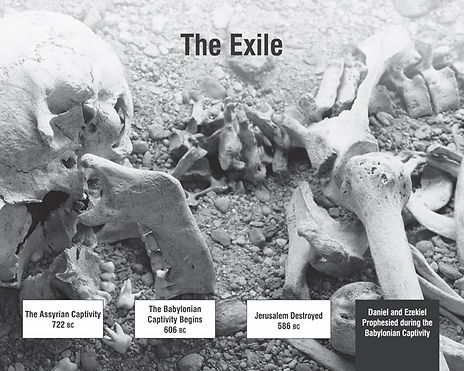
The Exile
While Israel and Judah were in captivity in Assyria and Babylon, God sent them prophets to communicate His word. The promises God made to Abraham, Isaac, and Jacob were still in effect, even if the children of Israel were not able to see the blessings of God in their lives at that time. God preserved a remnant of His people to ensure the promises He had made would be fulfilled.
Ezekiel Prophesied of New Life
Ezekiel prophesied during the Babylonian captivity. God gave him vivid examples of future events to act out and showed him wondrous visions. But Ezekiel also endured suffering and hardship. Two of his prophecies in particular stand out for their emphasis on new life.
A Heart of Flesh
The Spirit of God moved on Ezekiel to record a promise of God that wouldn't be fulfilled for almost six hundred years. Ezekiel recorded God's words: "And I will give them one heart, and I will put a new spirit within you; and I will take the stony heart out of their flesh, and will give them a heart of flesh: that they may walk in my statutes, and keep mine ordinances, and do them: and they shall be my people, and I will be their God" (Ezekiel 11:19-20).
Valley of Dry Bones
In Ezekiel 37, God gave Ezekiel another prophecy that pertains to new life. Ezekiel was carried by the Spirit of the Lord to a valley full of dry bones. God asked him, "Can these bones live?" Ezekiel responded, "O Lord God, thou knowest." God asked Ezekiel to prophesy to the bones, and God sent life into the bones (Ezekiel 37:1-10). Through this experience, God taught Ezekiel that despite the fact Judah and Israel had been divided, conquered, and captured, one day He would restore and reunify the Jewish people.
Daniel
Daniel prophesied during Israel's exile in Babylon. As with Joseph, Daniel's God-given gift caused him to rise in prominence in the court of Babylon. Although he was in the king's favor for a time, his unwavering devotion to God brought persecution upon him when he refused to cease praying to the God of Israel. Despite being cast into a den of lions, Daniel escaped unscathed and went on to prophesy of near-term events such as the rise and fall of kingdoms and empires s well as various end-time events. His prophecies were also mentioned in the gospels of Mathew (24:15) and Mark (13:14).
Esther
Esther was a Jewish woman who lived in Persia some time after the destruction of Jerusalem. She rose through the ranks from being a servant to a queen. Haman, one of the king's chief servants and an archenemy of the Jewish people, plotted the destruction of Esther and her people. After Esther called for prayer and fasting, God intervened and reversed the course of Haman's plot ending in Haman's own death. The message of the Book of Esther serves to illustrate God's saving grace for all who follow Him.
>>> In some ways our world today is like what Daniel and Esther faced with religion being a dividing line. What should we do when we feel society pulling us in one direction and our biblical convictions pulling us in another?
The conflict between society and religious values is not new. In the New Testament, Christians were pressured to renounce their Christian teachings. Acts 5:29 explains how they responded: "Then Peter and the other apostles answered and said, we ought to obey God rather than men." While we seek to live at peace with everyone (Romans 12:18), we prioritize obeying the Word of God above all else.