
Parables of Jesus
(27 Parables Explained)
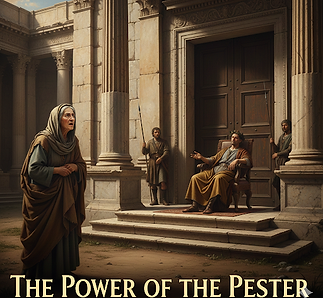
The Power of the Pester
The Persistent Widow
In Luke 18:1–8, Jesus tells a story that feels almost scandalous at first glance. It’s the parable of a widow who won’t take "no" for an answer and a judge who—to put it bluntly—couldn't care less about justice or God.
It’s a short story with a massive promise: Persistence pays off in the Kingdom of God.
The Setup: An Unlikely Hero
In the ancient world, a widow was the definition of "vulnerable." Without a husband or grown sons to advocate for her, she had zero social standing and even less legal muscle. On the other side of the bench sat a judge who "neither feared God nor cared what people thought."
She didn't have money for a bribe. She didn't have a powerful lawyer. All she had was a voice and a refusal to leave.
The Persistence: "Grant Me Justice"
Day after day, she showed up. She didn't change her request; she didn't soften her tone. She kept demanding what was right. Eventually, the judge cracked. Not because he grew a conscience, but because she was wearing him out!
Jesus uses this "argument from the lesser to the greater." If even a corrupt, cold-hearted judge will eventually do the right thing because of persistence, how much more will your loving Father respond to you?
Three Takeaways for Your Prayer Life
* Boldness is Not Rudeness
The widow wasn't being "annoying" to God; she was being faithful. Jesus told this parable specifically so that we would "always pray and not give up" (Luke 18:1). God isn't bothered by your "reminders." He is honored by your dependence.
* Delay is Not Denial
We often mistake a "not yet" for a "no." The widow waited. She endured the silence of the court. Persistence bridges the gap between the promise and the provision.
* Check Your Heart, Not Just Your Clock
The parable ends with a haunting question: "When the Son of Man comes, will he find faith on the earth?" Persistence isn't just about getting what we want; it's the primary evidence of our faith. It proves we actually believe God is who He says He is.
Final Thought
Are you on the verge of giving up on a prayer you’ve been praying for years? A wayward child, a health breakthrough, or a systemic injustice?
Don't stop knocking. The Judge of the Universe isn't like the judge in the story—He is already on your side, and He is moved by the sound of your voice.
.png)
The Mirror of the Heart
Pride vs. Humility
In the Gospel of Luke, Jesus tells a parable that cuts straight to the core of how we view ourselves and how we view God. It’s the story of two men who went to the Temple to pray, but left with two very different outcomes.
Two Men, One Temple
The setting is simple: the holy Temple in Jerusalem. Two men stand there, representing opposite ends of the social and moral spectrum of their time.
* The Pharisee: A religious elite. He was disciplined, followed every law, and was seen by society as the gold standard of righteousness.
* The Tax Collector: A social outcast. In the eyes of his peers, he was a traitor and a thief, working for the Roman occupiers.
The Prayer of Performance
The Pharisee stood by himself and prayed: "God, I thank you that I am not like other people—robbers, evildoers, adulterers—or even like this tax collector. I fast twice a week and give a tenth of all I get." (Luke 18:11-12)
On the surface, his "resume" is spotless. But look closer at his heart:
* Comparison: His sense of worth came from being "better" than someone else.
* Self-Sufficiency: He wasn't actually asking God for anything; he was simply reporting his own greatness.
* Contempt: He looked down on the very person God called him to love.
The Prayer of Penance
Far off in the corner, the tax collector wouldn't even look up to heaven. He beat his breast and said: "God, have mercy on me, a sinner." (Luke 18:13)
His prayer was short, honest, and desperate. He didn't offer a list of excuses or compare himself to the Pharisee to feel better. He recognized a simple truth: he was in need of grace.
The Divine Verdict
Jesus ends the story with a shocking twist for his audience:
"I tell you that this man [the tax collector], rather than the other, went home justified before God. For all those who exalt themselves will be humbled, and those who humble themselves will be exalted." (Luke 18:14)
What This Means for Us Today
This parable isn't just about ancient history; it’s a mirror for our own souls. It asks us a difficult question: Where is your confidence found?
If we find ourselves thinking, "At least I'm not like that person on social media," or "I deserve God's blessing because I've been good," we are standing in the Pharisee’s shoes.
The Gospel reminds us that we don't "earn" our way into God’s presence. We are all like the tax collector—broken people in need of a Savior. The beauty of this story is that the moment we stop pretending to be perfect, God meets us with overwhelming mercy.
Reflection Question: Is there a "tax collector" in your life that you’ve been looking down on? How might God be calling you to trade your pride for His peace today?

Investing for the King
Parable of the Minas
In Luke 19:11–27, Jesus tells a story that often feels a bit uncomfortable at first glance. Unlike the Parable of the Talents (where servants receive different amounts), in the Parable of the Minas, ten servants are each given exactly the same thing: one mina.
In the first century, a mina was roughly equivalent to three months' wages. It wasn't a fortune, but it was a significant "seed" to start a business. The King’s command was simple: "Put this money to work until I come back."
As we navigate our modern lives, this parable offers three profound truths about how we should view our time, our resources, and our ultimate purpose.
1. We All Have the "Same" Opportunity
While we all have different natural talents or financial backgrounds, every believer has been given the same Gospel and the same 24 hours in a day.
The "mina" represents the gift of the Kingdom—the grace, the Word of God, and the Holy Spirit. We are all equally equipped with the message of salvation. The question isn't how much we were given, but what we are doing with the "Common Grace" and the truth we possess.
2. Faithfulness is Measured by Action
When the King returned, he didn't ask his servants how they felt about his departure. He asked for an accounting of their productivity.
* The Proactive: One turned his mina into ten; another into five. They took risks, engaged with the marketplace, and worked diligently.
* The Passive: One servant wrapped his mina in a cloth and hid it. He was paralyzed by a distorted view of the King’s character, calling him "hard" and "exacting."
The takeaway? Fear often masks itself as "caution" or "piety." But in God's Kingdom, doing nothing with what you’ve been given is the greatest risk of all.
3. Our Present Work Shapes Our Future Authority
The reward in this parable is fascinating. The King doesn't just give the faithful servants more money; he gives them cities.
"Well done, my good servant!... Because you have been trustworthy in a very small matter, take charge of ten cities." — Luke 19:17
Our life today is a training ground. How we manage our "mina" now—our integrity at work, our parenting, our service in the church, our stewardship of finances—is preparing us for the responsibilities we will hold in the age to come.
Reflection Questions
* What is my "mina"? What has God entrusted to me that I might be "wrapping in a cloth" out of fear?
* How do I view the King? Am I serving out of a joyful partnership or a fearful obligation?
* Where can I "trade"? Where is there an opportunity this week to invest my time or influence for the sake of the Gospel?
The King is coming back. Let’s make sure that when He arrives, He finds us busy with His business, turning our small beginnings into a legacy for His glory.
(25)
(26)
(27)